Economics & Money
The Walls of Money: Why a Connected Humanity Needs Bitcoin
Why a Connected Humanity Needs Bitcoin
Why a Connected Humanity Needs Bitcoin
We talk to people on other continents, work across national borders, and order goods from around the world. Our economic relationships have long since become global. Yet the money we use to conduct them remains tied to political spheres of power. Bitcoin raises the question of whether this has to remain the case.
When Walls Lose Their Power
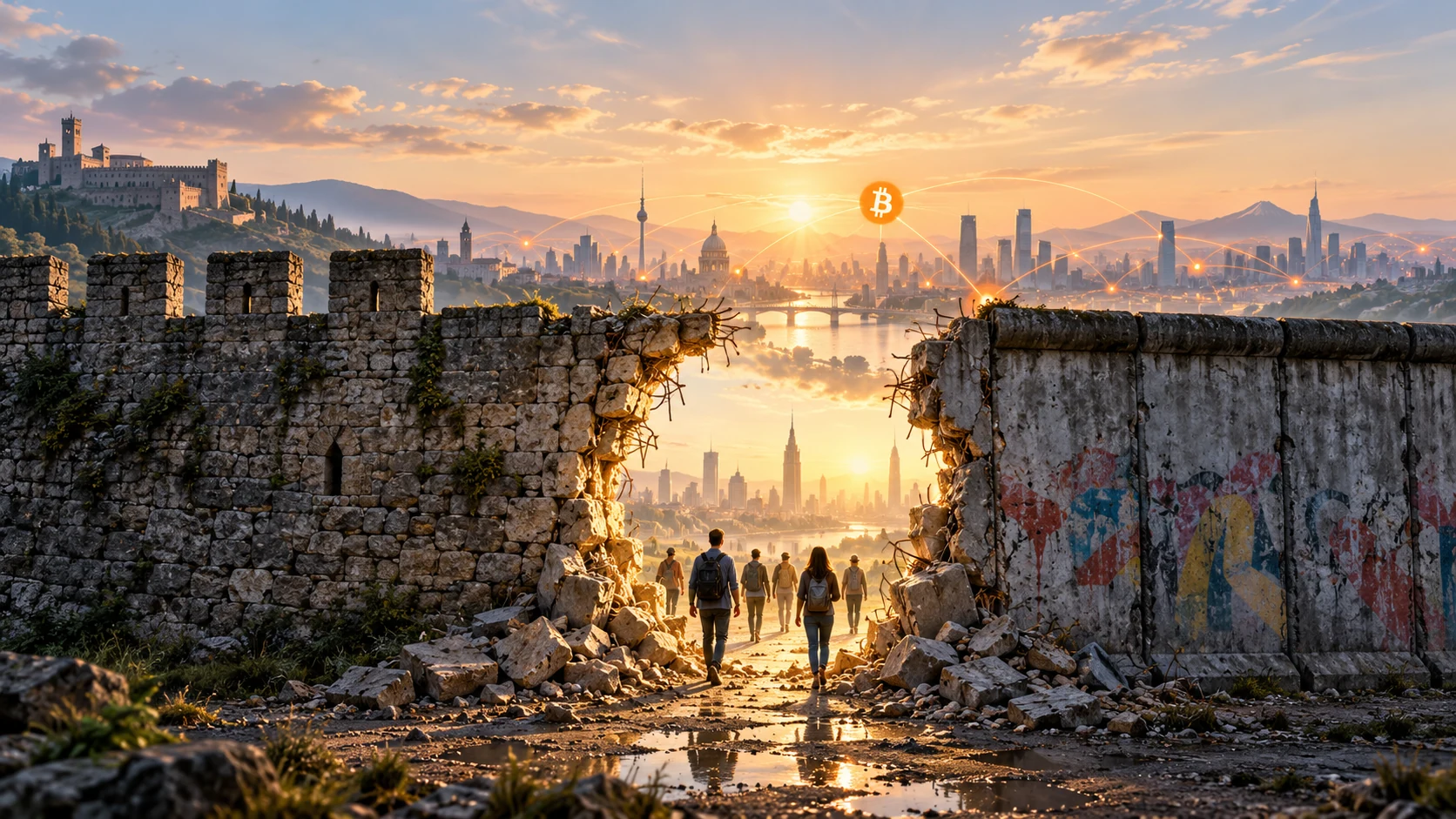
A wall is a promise: the order on one side will remain separate from the world on the other. In 1495, that promise was shattered at Monte San Giovanni by French artillery. On November 9, 1989, it broke again—at the Berlin Wall. These are two very different events, but both show that even seemingly permanent arrangements of power cannot maintain their boundaries forever.
In The Sovereign Individual, James Dale Davidson and William Rees-Mogg describe how technological change shifts the foundations of political power. Just as artillery once favored larger political entities, information technology might weaken the link between economic activity and territory. The comparison between 1495 and 1989 does not establish a 500-year cycle. It does, however, invite us to consider something important: institutions can lose their apparent inevitability when people discover new ways to cooperate.
Value Already Crosses Borders. Money Often Does Not.
Today, value is created across borders. A translator in Germany works for a client in Argentina alongside a graphic designer in Kenya. Files, video calls, and shared publications connect them directly. Yet payment still brings different currencies, banks, and eligibility requirements into the picture.
Conventional money can, of course, be transferred digitally and internationally. But a more convenient user interface does not in itself change the power structures behind a payment system. Who controls access? Who can change the rules? And what options does an individual have if they disagree with those rules?
A shared and openly accessible monetary network is a logical development for a society that works across the globe. Where someone lives should not determine whether they may participate. And a person's economic future should depend as little as possible on whether the institutions managing their money behave responsibly.
Who Sets the Rules of Money?
That is why I believe no government, institution, or individual should be able to change the fundamental rules of a globally used form of money unilaterally. Anyone who exchanges their work for money should be able to understand the conditions under which that money is created and transferred.
Bitcoin offers a concrete technical approach. Satoshi Nakamoto's white paper describes direct electronic payments without requiring a central financial institution. A shared transaction history, cryptographic verification, and proof of work provide the foundation for preventing the same bitcoins from being spent more than once.
Software checks the rules. Developers can propose changes, but they cannot simply impose their new version on everyone else. Someone running a full node uses software of their choosing to determine which blocks and transactions they accept. A change therefore does not automatically become a rule for the entire network.
This does not mean rule by infallible code. People write programs, make mistakes, and have to fix problems. The essential point is that agreed rules can be publicly verified and technically enforced—and that no one gets an exception merely because of their office, wealth, or reputation. Whether people value this system remains their choice.
Central banks and an elastic money supply have rationales of their own. Providing liquidity in crises and stabilizing a credit-based system are among them. Bitcoin does not automatically perform these functions. Anyone advocating a different monetary order must also grapple with credit, crises, and the difficulties of transition.
Yet Bitcoin already offers a real choice. People can hold and transfer a monetary asset without a central issuer, without waiting for everyone else to share their convictions.
Free Money Requires Responsible Users
That freedom is demanding. Lost keys can make savings permanently inaccessible. Those who delegate custody entirely to third parties create new dependencies. And a limited supply does not guarantee stable purchasing power: Bitcoin's market price fluctuates as demand and expectations change.
An open monetary network does not abolish the physical or political world. People need internet access, knowledge, and secure tools. A recipient must be willing to accept Bitcoin. The possibility of self-determination is therefore not enough. It must become usable in everyday life.
That is the standard by which we should judge the promise of free money: How much genuine freedom of action does it give ordinary people when saving, working, trading, and paying? How easy is it to understand and use? And how effectively can new dependencies be avoided?
Money Must Be Free
Our relationships have long since crossed the boundaries of political territories. We should therefore assess our monetary order against the needs of a connected society: open access, verifiable rules, and the freedom to decide for ourselves whom to trust with our economic future.
To me, that is why a connected humanity needs Bitcoin. It offers an alternative to monetary systems whose fundamental conditions are set for us by others. Its success should be judged by whether that alternative delivers greater self-determination in people's lives.
Money must be free: free to access, free to choose, and free from the unilateral control of any single power. A world in which people work together across borders should offer them that freedom for the value of their work as well.
Sources and Further Reading
- James Dale Davidson and William Rees-Mogg, The Sovereign Individual (1997).* Publisher's page with an excerpt. A framework for thinking about technological change, political power, and economic self-determination.
- Festa della Musica Italia, Monte San Giovanni Campano. Historical overview of the destruction of its fortifications by the troops of Charles VIII in 1495.
- Satoshi Nakamoto, Bitcoin: A Peer-to-Peer Electronic Cash System (2008).* White paper. The technical foundations of direct electronic payments and the prevention of double spending without a central clearing institution.
- Bitcoin.org, Frequently Asked Questions. FAQ on network control, software changes, self-custody, and risks.
This article discusses monetary institutions and economic freedom. It is not financial or investment advice.