Money & Life
Why we work for freedom – and keep putting it off
How much do we need to save before we take time to live?
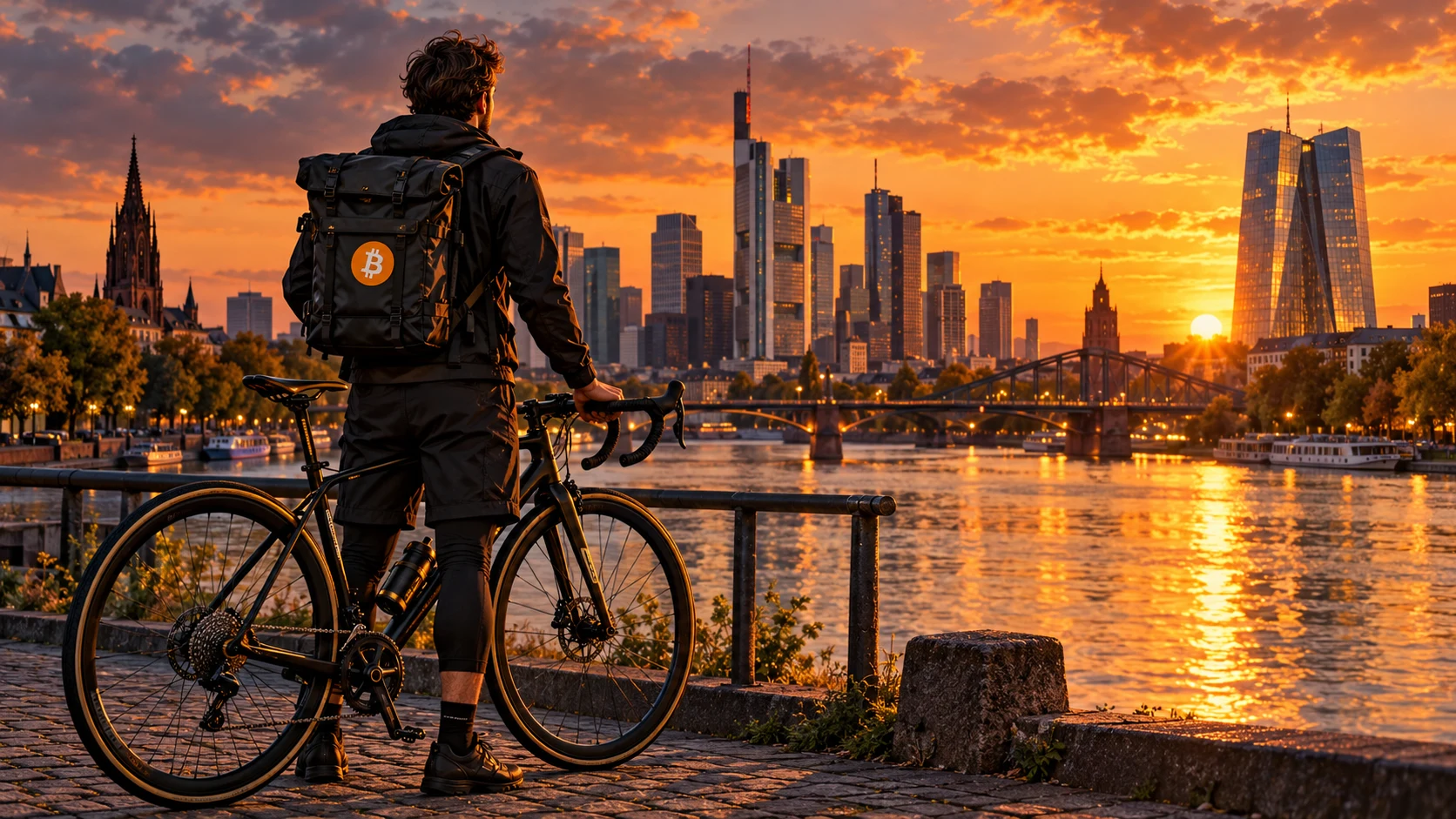
I worked as a bicycle courier in Frankfurt am Main for almost seven years. Around twenty deliveries a day, often covering eighty to a hundred and twenty kilometres: distances like these were part of my everyday life back then. When you earn your living on a bike, you feel what work costs: energy, attention and hours that are gone for good. You can accept more jobs and earn more money. You cannot get the day back.
Yet it would be wrong to see those years only as time I had sold. The exercise and the physical challenge were part of what I enjoyed about the job. I was outdoors, on the move, discovering Frankfurt from a different perspective. At first, I mainly knew the city from driving and had to learn my way around on a bike. Later, I barely needed a map.
That makes the question of work and freedom personal for me. Work can be demanding while also offering something you would not want to lose. What matters, then, is how much of the life I want to lead is already part of my everyday life – and how much I keep putting off until later.
What the streets taught me
As a bicycle courier, you encounter personal responsibility in a very immediate way. Can I see what is happening? Am I leaving enough space? Am I still alert, or am I far more exhausted than I want to admit? Rules can offer guidance. I still have to assess the situation myself.
That applies at a red light, too. Anyone who rides through one has more to consider than a possible fine. Other people may have to brake or swerve. In the worst case, someone gets hurt. Personal responsibility includes responsibility for those consequences.
Conversely, a green light does not protect me from someone else making a mistake. I can be in the right and still end up lying in the road. Rules matter. Looking and thinking remain my job.
The state can set rules and penalise violations. But it cannot monitor every situation or make every decision for me. The same applies to my body, my work and my money. I can accept help and delegate tasks. Even so, I want to understand what I am relying on and what consequences I might face.
Saved money is work already done
For me, the meaning of money begins with the work behind it. I have spent time and energy earning it. When I save some of it, I preserve something of that effort for later.
In this sense, saved money is stored time from my life. Of course, this is not an exact exchange rate. Different work pays differently, and not all wealth is earned through one's own labour. For my own savings, however, the connection remains: the work is done. The time it took has already passed.
A financial reserve can, in return, give me time in the future. It can allow me to turn down a job, work less or change direction. Part of its value lies in the decisions it enables me to make.
That is why I care about what happens to my savings. I want yesterday's work to retain its value tomorrow.
When the number stays the same and purchasing power fades
The European Central Bank aims for two per cent inflation over the medium term. Part of its reasoning is to maintain a safety margin against deflation, a general decline in prices. For savings that earn no interest, however, persistently positive inflation means declining purchasing power.
With inflation at a constant two per cent, €100,000 earning no interest would have purchasing power equivalent to around €55,200 today after thirty years. The number in the account would be unchanged. It would buy considerably less. Interest and other returns can offset that loss. Without an offset, the loss remains.
That is precisely what bothers me. I have worked and put aside part of my income. Afterwards, I have to make further decisions to preserve its purchasing power. Which investment is suitable? What risks am I taking? How much do I need to know? The work is finished. The concern about its value continues.
Inflation does not take away hours I have already lived. But it can reduce the room to manoeuvre that I earned through those hours. For me, that makes it a question of time as well.
What Bitcoin changes for me
This is where my interest in Bitcoin begins. Its rules limit the total supply and reduce the issuance of new bitcoin over time. A central bank cannot expand that supply at its own discretion. The rules are public and can be verified using your own software.
There is also the option of holding bitcoin in self-custody. Whoever controls the necessary keys can use their coins without requiring a custodian's approval for every transaction. That fits my wish to take responsibility for my money.
That responsibility has consequences. If I lose my keys without a usable backup, I may lose access. The market value can also fall sharply. A limited supply alone does not guarantee stable or rising purchasing power.
I see Bitcoin as an opportunity to preserve the purchasing power I have earned over the long term. I also think that growing use could increase its value. If that expectation proves right, my savings could give me more free time later. That is not certain. Precisely because this money represents my work, I have to take potential losses as seriously as the gains I hope for.
Bitcoin gives me more control over certain decisions. Whether I make them wisely remains my responsibility.
One more delivery – or is that enough for today?
At some point in a courier's working day, a simple question arises: do I take the next job, or do I go home? Another delivery brings in extra money. It also costs energy and another part of the day.
For me, saving involves the same trade-off. Putting more aside can make sense. But to do so, I often spend exactly what I hope to have more of later: time I am free to use as I choose.
My aim is not to leave all work behind. Courier work in particular shows me that a job can itself contain something I associate with freedom. For me, part of financial independence is therefore being able to do work I enjoy – while still having the option of stopping for the day.
Of course, reserves are necessary. Rent and unexpected expenses do not disappear because I would rather work less. Anyone caring for other people has additional responsibilities. And many people lack even the financial room to choose between more work and more time off.
Where that room exists, however, the question is worth asking: when is it enough? First, a larger reserve. First, another year of work. First, wait until things are more secure. Each individual postponement can sound sensible. Taken together, they can produce a life in which the freedom you hope for always begins later.
Bitcoin can also become a reason to postpone life
Bitcoin does not automatically solve this problem. Anyone convinced that its purchasing power will rise over the long term may find particularly good reasons not to spend anything today.
What might the satoshis for a trip be worth in ten years? How much more would I have later if I gave up that week off now? Such thoughts can encourage a more considered approach to money. But they can also make every expense feel like a mistake.
Then the goal shifts. Originally, I wanted to save so that I could make decisions more freely. At some point, I begin making decisions solely to save as much as possible.
Waiting has a cost, too. A trip might be postponed. Whether my health, the opportunity and the people I want to share it with will still be the same later is something I cannot know.
That is why I believe every savings strategy should include a personal question: what am I actually putting this money aside for? And how will I recognise when I have enough for that purpose?
Taking responsibility for my own limits
On a bike, I can overestimate my strength for a while. In the long run, it is hard to ignore my physical limits. With work and saving, the boundaries are often less obvious. There is almost always a reason to do a little more.
A larger reserve can make sense. But I want to know what it costs me and what it makes possible. How many additional working hours is the next financial cushion worth to me? What freedom do I actually gain from it?
For me, that also means taking the present seriously. If I enjoy my work, the time I spend doing it is not lost. And if I can afford a break, I do not have to justify it by saying it will make me more productive afterwards. Both can have value in their own right.
There is no number that works for everyone. The answer depends on responsibilities, needs and personal circumstances. It can change. What matters to me is asking the question in the first place.
Otherwise, the desire for security becomes a task without an end. The balance in my account can keep growing. The time available in my life cannot.
Freedom requires a decision
My years as a bicycle courier shaped my attitude towards personal responsibility. Today, that attitude also draws me to Bitcoin. I want to be able to hold my own money and understand the rules it operates under. Above all, I want to make conscious choices about what I have earned.
That includes using it at some point. Savings can allow me to work less, try something new or spend time with people who matter to me. No account balance makes that decision on my behalf.
Saved money represents time I have already spent. What I hope to gain from it is more freedom for the time that remains. Some of that freedom can lie in the work itself. Some of it lies in ending the working day.
At some point, I want to be able to say: that is enough for today. I am going home.
Sources and further reading
- Florentin Schuhmacher, FAZ: Bicycle couriers – “In the evening I’m a hero” (5 September 2014). Deliveries, daily distances and knowledge of the city refer to the period covered by that report.
- European Central Bank: Price stability objective – two per cent inflation over the medium term. Purchasing-power example: own calculation, €100,000 / 1.02^30 ≈ €55,200; constant two per cent inflation, no returns. Not an inflation forecast.
- Bitcoin.org: Frequently asked questions – supply, issuance and price movements.
- Bitcoin.org: Securing your wallet – self-custody and backups.