On the Road · Camino de Santiago
My Camino: At My Own Pace All the Way to the Sea
In the summer of 2011, the Camino took me from Saint-Jean-Pied-de-Port via the Camino Primitivo to the sea. A travel story about choosing my own stages, encounters and roughly a thousand kilometres on foot.
In 2010, I was in hospital after a Snakeboard accident. My mother brought me Hape Kerkeling’s “Ich bin dann mal weg” — published in English as “I’m Off Then”. Roughly a thousand kilometres on foot across Spain? At the time, I could barely imagine it. Still, the idea would not leave me alone.
After recovering, I bought a backpack, hiking boots and poles, and began exploring the Taunus on foot. To prepare for the long climbs in the Pyrenees, I walked some steep paths several times in succession. Even that did not entirely take away my worry about the first stage.
In August 2011, I flew from Hahn via London to Biarritz and continued to Saint-Jean-Pied-de-Port. On the plane, I was already sitting beside someone with the same plan. During the first few days, we would repeatedly find ourselves walking together.
There was a heavy thunderstorm the night before we set off. The next morning, I registered at the pilgrim office and headed towards Roncesvalles with many others. No other stage had filled me with so much apprehension.
Then came the surprise: I managed the walk much more easily than expected. The training in the Taunus had evidently done more for me than I had given myself credit for.
Before long, I found my rhythm. I often walked between 36 and 42 kilometres a day. I noticed how strongly the stages suggested in the guidebook shaped the traffic. By midday, backpacks were already waiting outside some hostels on behalf of their owners.
I usually wanted to keep walking. So I shifted my daily destinations away from the suggested stages. That way I found a bed without difficulty and constantly met new people. Some I saw for just one evening; others accompanied me for several days.
On the fourth morning, my thighs felt so tight that getting started was a struggle. Then I saw a pilgrim ahead of me whom people had already mentioned in Saint-Jean: an American heading to Santiago with one leg and on crutches.
We talked briefly. He was from San Francisco. His determination gave me fresh courage, and suddenly my own steps felt lighter too. After our encounter, I carried on. We never saw each other again.
Along the way, I met a yoga teacher from London and a biology student from Greifswald. Both also walked long stages, and we spent a few days together. The yoga teacher spoke Spanish; listening to her, I tried to find my way into the language. Later, I managed something similar while listening to conversations between a Belgian and a Dutch punk. At some point, I understood more than I had expected at the start.
The small things stayed with me too. A Frenchman recommended sweetened condensed milk as a source of energy. A priest borrowed my carefully rationed shower gel and returned the bottle almost empty. After a while, I even bought water to brush my teeth because the chlorine taste from the tap bothered me so much.
My feet were causing increasing trouble. I developed blisters, eventually even underneath existing blisters. A nurse treated them and advised me to rest for a few days. I still wanted to carry on. At the time, my ambition was stronger than my willingness to take that advice.
In León, I left the Camino Francés and took the route through Oviedo to join the Camino Primitivo. I wanted to avoid the heavier crowds approaching Santiago.
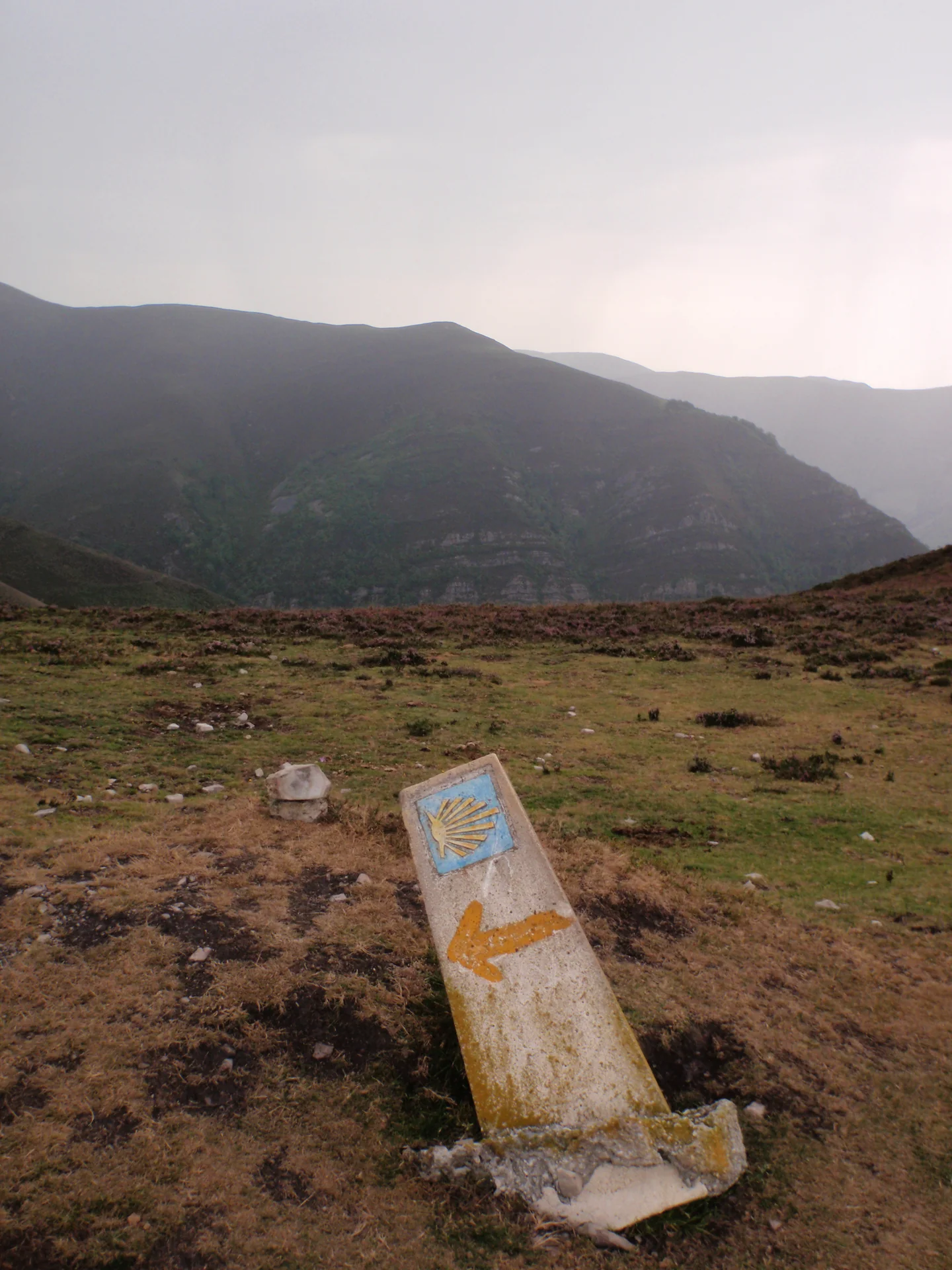
On this stretch, I experienced a different Camino. A group of around 25 people became my small community for those days. We kept meeting again; beyond them, I saw hardly any other pilgrims. Some hostels operated on donations. For me, this quieter route was among the most beautiful parts of the journey.
For the last fifty kilometres or so, I rejoined the Camino Francés. Suddenly it was crowded. To find people I had met during the first weeks, I even walked against the usual direction for a day. In Ribadiso, I did find them again. The student from Greifswald had met more Germans by then, and we walked to Santiago together.
There, an older woman unexpectedly invited me to eat. Somewhat incredulous, I accepted. She served tuna patties — in my adopted home today, they would probably be called Thunfischpflanzerl. Afterwards, we watched a Spanish documentary. I did not understand a word.
At the pilgrim office, I was asked to state why I had walked the route. According to the information given at the time, a walk motivated purely by sport would have earned me a different certificate. The Compostela was tied to religious or spiritual motives. I wanted the official document and ticked the appropriate box. That left a bitter aftertaste: my answer was shaped by which document I wanted to receive.
I spent far longer on the square in front of the cathedral than in the pilgrim office. Over three days, I sat there for many hours watching people arrive. People whose faces showed their joy at having completed the journey.
I wondered whether Santiago might be one of the happiest cities in the world. On that square, at least, it felt that way to me. How local people experienced the daily stream of pilgrims was probably a different question.
On the third day, we joined the traditional free pilgrim meal at the hotel beside the cathedral. Afterwards, I lay down for a nap on the square. Then it was time to continue towards Finisterre.
We had barely left Santiago when it started pouring. We found shelter in the basement of an unfinished building and spent the night there. The rain stayed. Over the next two days, I covered only about thirty kilometres altogether.
Eventually, I faced a decision: return to Santiago or continue to the sea? The next morning, the sky cleared. I decided to head towards Finisterre, however far I could get that day.
Together with a man from Vienna, I walked approximately 65 kilometres in thirteen hours. We reached the lighthouse shortly after sunset. Sky and sea were still tinted red. We had just missed the sun itself.
Unable to find a hostel so late, we spent the night in a camp near the beach. The following day, I continued to Muxía. On my final night, I slept on a bench by the harbour. The next morning, I took the bus to Santiago airport.
The Camino was a wonderful experience. Even so, I would probably not walk it again. The crowded stretches were often too much for me, and there are so many other places I want to discover.
I brought one question home: I had walked roughly a thousand kilometres across Spain. Why had I never given my own country that much time?
After that, I wanted to discover Germany on foot too.