Bitcoin & Ownership
Who Owns Bitcoin? Retail Investors, Whales and Wall Street
Bitcoin can be traced on the blockchain down to the last satoshi. Yet establishing who owns the coins is surprisingly difficult. Since the launch of US spot ETFs, another layer has emerged: millions of investors can have a stake in Bitcoin while a small number of service providers hold the keys.

Anyone following the debate about Bitcoin encounters two different pictures. On one side is money that people can own themselves and transfer without a bank. On the other are large funds, companies and asset managers whose Bitcoin holdings dominate the headlines. How do these pictures fit together? And how much Bitcoin is actually still in individual hands?
The answer depends on what we count: economic exposure, balances held at blockchain addresses, or control of the keys. These layers are connected, but they produce different distributions.
How reliable is the 70% / 30% split?
The idea that individuals hold roughly 70% of all bitcoin and institutions hold 30% sounds straightforward. Yet the sources examined here do not establish it as a current, clearly substantiated ownership statistic. We would first need to define what counts as individual ownership and which holdings fall under institutions.
An individual investor can hold bitcoin in self-custody, keep it on a trading platform or own shares in a Bitcoin ETF. In the last case, the investor has economic exposure to the bitcoin price, while the coins are held by the fund. A breakdown by investment vehicle assigns those holdings to the ETF; a breakdown by ultimate investor would also have to establish who holds its shares. The iShares Bitcoin Trust describes precisely this form of access through an exchange-traded security.
Known institutional holdings therefore cannot simply be subtracted from the total to produce a complete figure for individual ownership. The remaining coins are initially just a residual category. Their ownership needs to be examined separately rather than assigned wholesale to one group.
How much bitcoin is held in ETFs?
The US spot Bitcoin ETFs tracked by Bitbo held a combined total of approximately 1.258 million BTC when the data was accessed on 21 September 2026. That amounts to roughly 6.0% of the maximum supply of 21 million BTC, or 6.3% of the approximately 20.09 million BTC already issued. Even the choice of denominator changes the percentage.
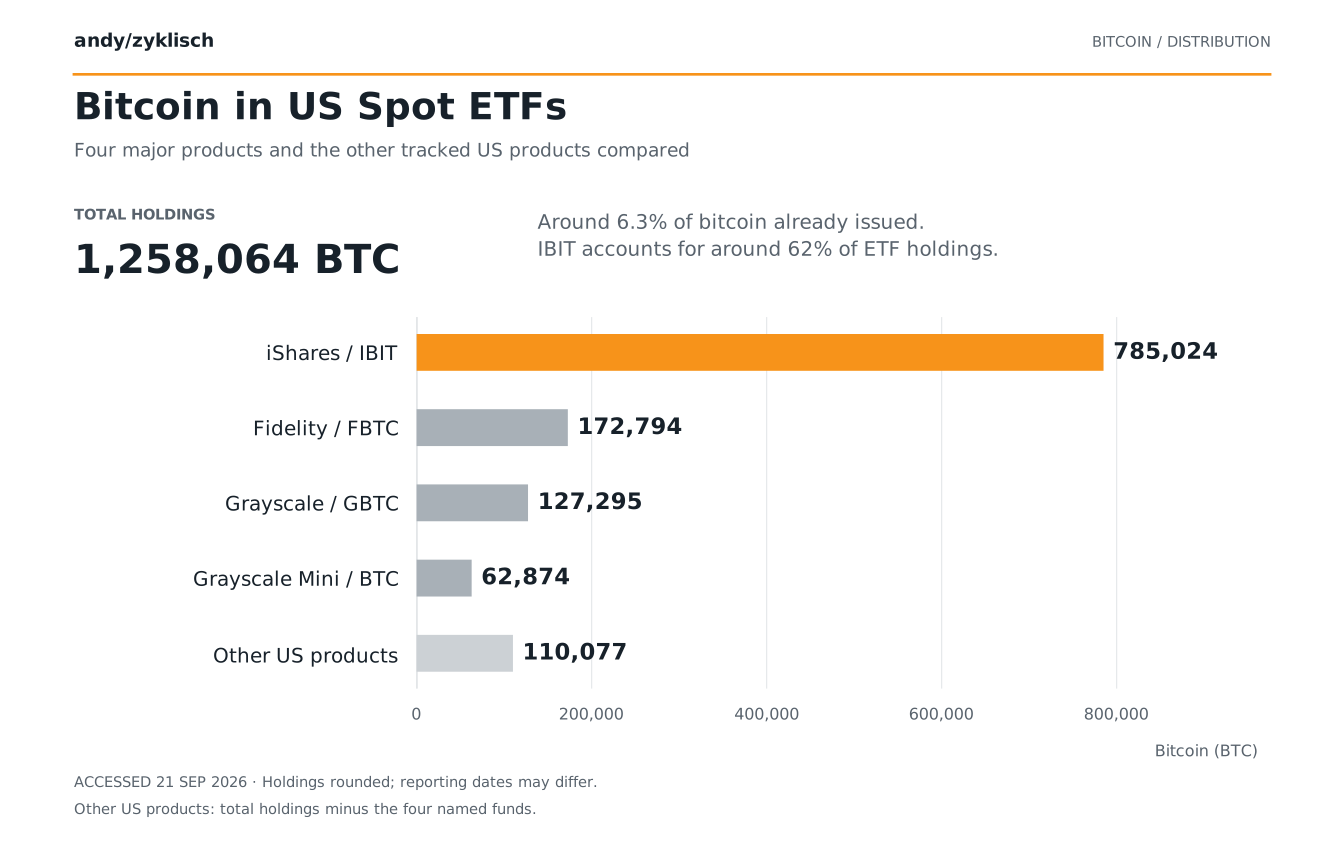
Within this group, IBIT accounts for around 62% of the bitcoin held. That reveals substantial concentration at one product provider. Nevertheless, saying that “BlackRock owns this bitcoin” would be misleading: assets held by a fund and the asset manager's own corporate assets are different things. Investors hold fund shares; those shares do not give them their own keys to the underlying coins.
Companies and governments are part of the picture too
US ETFs account for only part of the known large holdings. In its worldwide overview, last updated on 18 September 2026, Bitbo lists approximately 1.455 million BTC in its ETF category, which also includes other exchange-traded products. Its database additionally records around 1.208 million BTC at publicly listed companies and roughly 442,000 BTC at privately held companies. “Private companies” means businesses that are not publicly listed, rather than individual retail investors.
These overviews are useful snapshots, but they are not a comprehensive worldwide ownership register. Nor should their categories be added together without checking: a mining company's holdings may already be included in the corporate figures. Similarly, coins underlying a fund must not be counted again as a separate holding of its custodian. For government holdings, we also need to ask whether the coins were bought, mined or seized. A large wallet alone does not answer that question.
What has changed since January 2024?
On 10 January 2024, the US Securities and Exchange Commission approved the exchange listing of several spot Bitcoin products. This substantially expanded access through securities accounts. For a discussion of distribution, the date is a useful starting point: these products allow new investors to enter while existing investors can change the form in which they invest.
The ETF story nevertheless began with existing bitcoin holdings. Grayscale's GBTC was converted from an established trust into an ETF. Subsequent outflows from the product were associated in part with investors switching to cheaper alternatives. The current combined holdings of US ETFs therefore cannot be interpreted entirely as bitcoin newly purchased since January 2024.
River's adoption report offers a sense of the scale of the later shift. It estimates that individuals sold approximately 696,000 BTC in 2025, while companies, funds and ETFs, and governments together bought nearly one million BTC. These figures indicate a substantial shift towards institutional forms of investment. However, they represent neither ETF purchases alone nor a direct balance between exactly two parties.
The movement is also not consistently in one direction. In an interim assessment of the still ongoing third quarter of 2026, published on 18 September, River reports particularly strong buying by individuals again. This does not yet establish a lasting reversal. It does show why a fixed percentage can be less informative than asking which group is accumulating or reducing holdings over a particular period.
What the Bitcoin Rich List actually shows
At first glance, the Rich List appears to rank the wealthiest Bitcoin owners. In fact, it ranks blockchain addresses by their balances. When BitInfoCharts was accessed on 21 September 2026, addresses holding at least 100 BTC accounted for approximately 61.9% of the bitcoin recorded. The breakdown by address size was as follows:
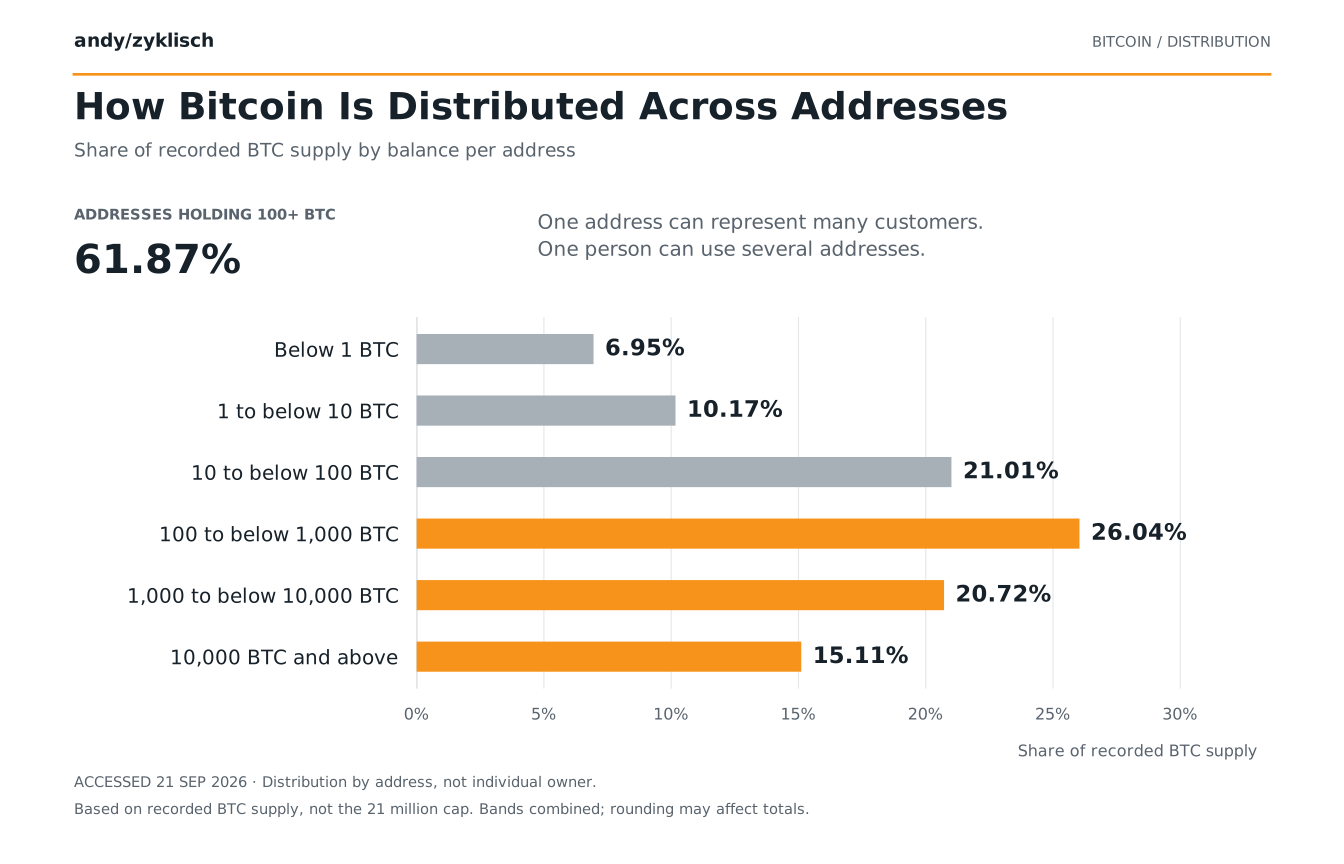
This is substantial concentration at the address level. Yet the four largest addresses in the list are attributed to Binance, Robinhood and Bitfinex. That alone illustrates why four addresses do not translate into four personal fortunes.
One person can use many addresses. Conversely, a service provider can pool coins belonging to numerous customers at just a few addresses. Glassnode identifies this distinction between addresses and economic entities as a fundamental problem in distribution analysis. Even methods intended to identify related addresses rely on assumptions and cannot provide a complete list of the actual owners.
A thought experiment illustrates the effect. A thousand people each hold 0.1 BTC. If they all use separate addresses in self-custody, the result is many small balances. If the same coins are pooled at a single address controlled by a service provider, that address suddenly holds 100 BTC. The economic claims of those thousand people need not have changed. Nevertheless, the Rich List looks more concentrated.
Lost coins and Satoshi's uncertain role
The distribution also includes bitcoin that may no longer be accessible to anyone. If all the necessary keys and backups are lost, the balances remain visible on the blockchain but can no longer be spent. Long periods of inactivity alone do not prove such a loss. Holdings left untouched for years may simply reflect a deliberate decision to hold for the long term.
The early mining holdings attributed to Satoshi Nakamoto introduce a particular source of uncertainty. Such attributions rely on analysis and estimates; River's overview also labels Satoshi's presumed holdings accordingly. They do not establish who, if anyone, can access those coins today.
For interpretation, this means that a share of the maximum possible supply, a share of coins already issued and a share of coins actually available are different measures. Subtracting presumed losses increases the percentages held by everyone else. The apparent precision of an extra decimal place must not obscure the uncertainty in the estimate of lost coins itself.
Who holds the keys becomes the crucial question
These distinctions point to a possible development: the number of people with an economic stake in Bitcoin can grow while the technical ability to move their coins becomes concentrated among a few providers. More investors do not automatically mean more independent custodians. An examination of ownership distribution should therefore always include a second question: how is control of the keys distributed?
For investors, these arrangements involve different trade-offs. A security can make access easier through a familiar brokerage account. Self-custody, by contrast, allows transactions without a custodian's approval and requires careful management of keys and recovery arrangements. A discussion of concentration should take these practical differences as seriously as the size of individual holdings.
Holding more bitcoin does not confer a network majority
A large bitcoin balance does not give its holder corresponding voting rights over the protocol. Bitcoin is not a corporation in which more shares automatically mean more votes. Network participants verify transactions and blocks against the rules of their software; owning coins replaces neither this verification nor the computing power used in mining.
Economic influence still matters. Large buying or selling decisions can affect the market. Concentrated custody can also create shared dependencies. That does not mean, however, that a fund holding a particular percentage of all coins has the same percentage of control over Bitcoin.
The question “Who owns Bitcoin?” therefore goes far beyond a ranking. ETFs, companies and individual holders do not form a simple either-or division: individuals can own fund shares, while large addresses can represent many separate customers. A sound assessment must distinguish holdings, economic exposure and control of the keys. Only then can we judge whether Bitcoin ownership is becoming more widely distributed, and where new forms of concentration are emerging at the same time.
Sources and further reading
- Bitbo – Bitcoin dashboard – US ETF holdings and issued BTC supply; data for Figure 1. Accessed 21 September 2026.
- iShares – iShares Bitcoin Trust ETF (IBIT) – Product structure, exposure through fund shares and risks.
- Bitbo – Bitcoin Treasuries – Tracked worldwide fund and corporate holdings; updated 18 September 2026.
- SEC – Approval of spot Bitcoin ETPs – Statement of 10 January 2024 on exchange listing of spot products.
- Reuters – Grayscale CEO sees bitcoin ETF outflows reaching equilibrium – GBTC outflows and switching between products; 10 April 2024.
- River – Bitcoin Adoption 2026 – Estimates of changes in holdings during 2025; published 24 February 2026.
- River – Q3 2026 change in bitcoin ownership – Interim assessment of the ongoing third quarter; published 18 September 2026.
- BitInfoCharts – Bitcoin Rich List – Address size bands and attributions; data for Figure 2. Accessed 21 September 2026.
- Glassnode – Bitcoin Supply Distribution – Addresses, economic entities and exchange holdings; analysis of 2 February 2021, used here only for its methodology.
- Bitcoin.org – FAQ – Lost bitcoin, the network and the limits of individual control.
- River – Who owns the most bitcoin? – Early mining holdings attributed to Satoshi; treated as an estimate.
- Bitcoin.org – Securing your wallet – Self-custody, keys and wallet backups.